Author Archives: Father L
The Most Blessed Trinity
Feast of the Most Holy Trinity
Beloved in Jesus Christ,
in the 14th chapter of the Gospel of John, St. Philip makes a request to Jesus. ‘Lord, show us the Father, and then we will be satisfied.’
.
– Show us the Father? – For a long time, Jesus had been telling them about his Father in heaven; and he even had told them: ‘I and the Father are one.’ So here comes Philip, and he says: ‘Show us the Father.’ Jesus says, ‘Philip, how long have I been with you explaining these things; if you’ve seen me, you’ve seen the Father!’
.
Jesus is the revelation of God in the world. God has ‘put on flesh,’ to be with his people, to walk with us, to love us, and to teach us something about what God is really like.
.
In Our Lord’s public life, he spoke many times about his Father in heaven, and he usually did it with parables. For example, the story of the Prodigal Son. This son, who leaves home and wastes his father’s fortune on loose living – But he comes to his senses and returns to his Father and asks for forgiveness, asking to just be allowed to work as a hired man. But this Father not only forgives him, he throws his arms around him, kisses him, and throws a party. Christ tells many such stories really, to teach us about what God is really like.
.
Cardinal Ratzinger, in his book Introduction to Christianity, he says in so many ways, we see what God is like through Jesus: God is loving, he is just, he forgives, he is filled with emotion when his child returns, he yearns for us.
.
Still, the world says that such things are ridiculous; yes, they will admit that there is probably some form of ‘supreme being;’ but it is absurd, they say, that this Being should concern himself with us, or come down to us. They say that we are naïve to think this; that these ideas are left over from a primitive world of ignorant people.
Our tiny and unimportant planet – this speck of dust in the universe, shows that we are nothing; it is absurd that a supreme being would concern himself with us, with our sins, or our problems –
They will say that God is not like that Father who throws his arms around a lost son and kisses him. God is like a Force or an Energy-field in the Universe. How vast is the universe, and what a tiny, unimportant speck our earth is, so GET REAL! – So say the “modern people.”
.
But in fact, things are really flipped around just the opposite. For these “modern people,” THEIR God is actually too small. They have made their idea of God, as a narrow image of themselves; an idea that God is not able to embrace the whole universe and each person – as if God has limitations and is not able to leave his chair to visit the heart of each person. Their God is way too small. The True God is actually very great.
.
God reaches down to the smallest, because to him, nothing is too small. This is the true greatness we would expect from a Supreme Being, that the great would stoop down to the little.
.
Imagine a powerful executive of Chase Manhattan Bank; why would such an important person have any interest in helping a dirty, street person in the gutter? Well, if he does help such a person, we would call him great. Then isn’t God greater because he compassionates his tiny creatures?
If he stoops down to this speck of dust, and takes concern over each of our problems, unite himself to us, and suffers our own life with us?
.
Today is the Feast of Most Blessed Trinity. And this is a uniquely Christian revelation, that God is a communio of Persons.
Buddhism, Islam, the other religions – they don’t know this about their Creator, they don’t know. they don’t know what St. John says straight out in his Epistle: ‘God is love.’ We know this because it was revealed by Christ.
.
You can’t have love, by one person. There must be a lover, and a beloved. God himself, if we may say, is an eternal chase of love. 3 Persons in One God. The Father loving the Son, the Son loving the Father, and that LOVE is the Person: the Holy Spirit.
.
Now Our Savior has said that if we love God, the Three Persons will come to live in us. ‘If any one love Me, my Father will love him, and we will come to him, and we will make our abode with him (John 14:23).
.
Calling on these 3 Divine Persons then, must be part of our daily life. Speaking every day to Our Heavenly Father, to Jesus, our Savior, and to the dear Holy Spirit
.
It was by calling on these Divine Persons, that a glass of poison shattered, to save St. Benedict. It was by calling on these Divine Persons that St. Anthony fought the devil, that St. Catherine challenged the emperor, and St. George defeated the dragon. It was in the Name of the Father, Son, and Spirit that St. Lawrence healed the blind, St. Sebastian healed a mute woman, and the martyrs gave their lives.
.
The Father, the Son, and the Holy Spirit – These are the Divine Persons by which Jesus commanded us to batpize: ‘I baptize you in the Name of the Father, and the Son, and the Holy Spirit.’
.
We praise these Divine Persons every time we say the Glory Be. Glory be to the Father, and to the Son, and to the Holy Spirit, as it was in the beginning, is now and ever shall be, world without end. The Glory Be is one of the earliest-known prayers praising the Holy Trinity, and it was an answer to the heretics who denied the Divinity of Christ; ths prayer, the ‘Glory Be,’ should certainly be part of our daily life.
.
God is not a Force, or an Energy-Field, or a vapor; He is a communio of Persons. The meaning of the Holy Trinity is that God is love. And the world of nature shows this God of love: St. Mary Magdalene de Pazzi, when holding a flower in her hand felt wounded by Divine love, saying, God has thought of creating this flower – that I might love him.’ The blue sky, the birds of the air, every tree and each star above, seems to say to us, ‘I am a messenger from God – He loves you.’
.
Mary can show us the way into the heart of the Holy Trinity. St. Alphonsus says, see with what love the Most Holy Trinity blessed Mary. The Father crowns her by sharing his power with her, the Son his wisdom, the Holy Spirit his love. Well, God desires the same for us. He wishes to share with us his power, his wisdom, and his love. May all things be to the eternal glory of the most holy Trinity.
.
Entrusted to the prayers of St. Teresa of Avila
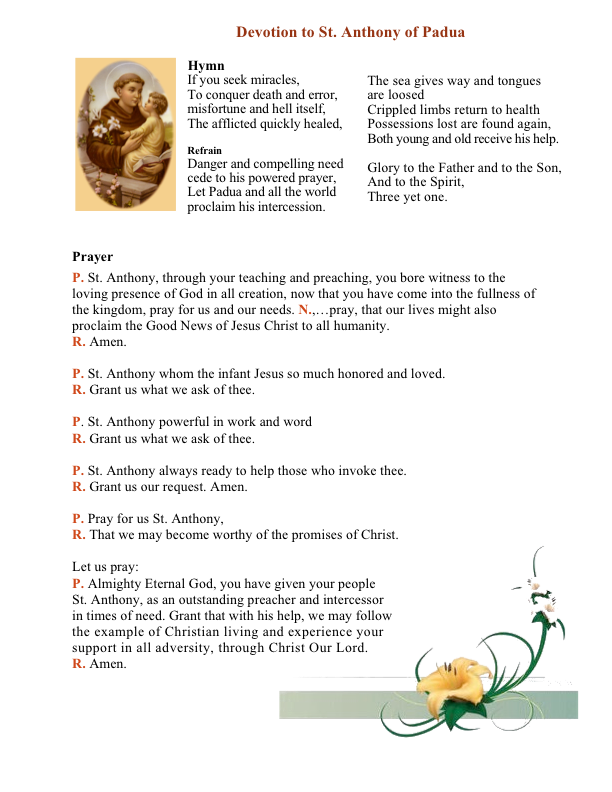
St. Anthony of Padua
Beloved in Christ, today is the Feast of St. Anthony of Padua. St. Anthony is the patron of lost things, but also a hundred other causes.
.
He was born in Portugal and entered the Augustinian monastery in Lisbon when he was 15. He became a priest, and it was there that he developed a great understanding of the Sacred Scriptures. Now it happened at that time, that many Christians were being martyred across the Mediterranean in Morocco. Franciscan missionaries were being killed by the Muslims. The bodies of these martyrs were for a time kept at the monastery where lived St. Anthony; one night, a monk saw Anthony kneeling at the caskets of those brave martyrs with his head resting on their caskets. He too yearned to die for Christ.
.
He joined the Franciscans, and did travel to Morocco, but God had other plans. He became ill and had to return; on the voyage home his boat was driven off course, and he landed in Italy where he really began his Franciscan life. One day he was at an Ordination Mass, and it turned out, that the priest who was supposed to preach did not arrive. With no warning, Anthony was asked to preach in front of the bishop and many dignitaries. With no preparation, he stepped to the pulpit, and began to speak. His words moved the heart of everyone present. He quoted the Sacred Scriptures as if he knew the entire bible by heart – which he did. This quiet Franciscan was now discovered to have an amazing gift.
.
St. Francis himself sent Anthony to preach in city after city. He went through Italy and into France as well. He was such a forceful preacher that shops closed when he came to town, and people stayed up all night, waiting for his sermons. The center of his ministry became the city of Padua, where he was beloved by the people; he died there in 1231.
.
One custom on the Feast of St. Anthony is known as “St. Anthony’s Bread” and it goes back to the year 1263. In the city of Padua there lived a family in which the mother left her 20 month old son Thomas alone in the kitchen. The little boy, while playing, ended up head first in a tub of water and drowned. His mother, finding him lifeless screamed in desperation, but then composing herself, she knelt down and prayed to Saint Anthony for help. She made a promise that if he would bring her son back to life, she would donate to the poor an amount of bread equal to the weight of the child. Her prayer was answered, the boy came back to life, and she kept her promise.
.
St. Anthony’s Bread involves the giving away of bread to the poor, blessing bread at church and giving it away, or giving alms to the poor. (Tonight at Mass we blessed some St. Anthony’s Bread for every one to take home. We then venerated the relic of St. Anthony.)
Rash Judgment
Friends in Christ, Our Lord today gives us a warning about the wrong path in the spiritual life. ‘Be not angry – you will be liable to judgment. ‘Call no one Raqa – that is idiot – you will answer to the Sanhedrin. ‘Call no one a fool – you will be liable to the fire of hell.
.
Judging another wrongly can lead to a crescendo of evil in the heart, and it all begins with suspicion. It is very easy to form an opinion of someone. We dream up all sorts of things about a person. But how many times are we wrong about what we thought of them? This is called rash judgment, caused by evil suspicions. (Summa Q. 60) St. Thomas says that suspicion is evil thinking based on slight indications, and this is due to three causes.
.
First, because a person is evil in himself; his own evil heart makes him prone to think evil of others, We see malice in others when it lives in ourselves.
.
Second, it can be because one has ill-will toward that person. If you already despise a person, then any slight indication will make you think evil of him.
.
Third, it can be because of much experience: says St. Thomas: “old people are often very suspicious, because in their experience, they have seen many times the failings of others.”
.
When one begins to doubt another’s goodness from slight indications, this is a venial sin; But when we believe a person to be wicked, in a grave matter, from a mere slight indication, this is a mortal sin. It is contempt for our neighbor. To think great evil of a person without sufficient cause, is to despise him, and do him injury. The Lord speaks of this when he says, to call someone a fool will make them liable to the fire of Gehenna.
.
Consequently, unless we have evident indications of a person’s wickedness, we ought to consider him good, We should interpret in the best light, whatever is doubtful. St. Francis de Sales says, we must always put the best interpretation on the actions of our neighbor.
.
Now this may lead us to be wrong from time to time, thinking our neighbor good when he is not. But there is no sin in this. But to have an evil opinion of a good person, is to do him harm.
.
How can we think the best of another? One way, is to recall for ourselves some times when we WERE very wrong about what we thought of someone. There certainly were times when we thought evil of a person and were completely mistaken. The Lord says, all thoughts will be revealed on the last day. So, let’s make them good thoughts.
St. Ephrem
Friends in Christ, today is the Feast of St. Ephrem. He was born about the year 406 to pagan parents, who, when he became a Christian as a boy was thrown out of their house. Eventually, at age 18 he was baptized, and for 25 years he assisted the work of the bishops at Nisibis through many difficult times. When the city fell to the Persians in 350AD, Ephrem retired to a cave in a rocky hill overlooking Edessa. Here he led an austere life of penance, eating little. It was in this cave that he wrote most of his spiritual works.
.
Ephrem was very short, he had no hair or beard, and his fasting and penances caused him to look rather old. He was not a recluse however, and often visited the city of Edessa where he preached to the people. He had a fiery speech, and often spoke of the 2nd coming of Christ and the final judgment, leaving the congregation in tears.
.
Ephrem noticed that Gnostic heretics would often use popular songs to teach the people false ideas about the faith. Seeing the power of music, he imitated the enemy’s tactics, and introduced sacred music into the Liturgy which was sung by a women’s choir. In this way, he completely supplanted the Gnostic hymns by hymns which taught the truth of the faith.
.
Late in his life, he was ordained a Deacon, and so he is known as ‘St. Ephrem the Deacon.’
.
In the winter of 372AD there was a famine in the land, and his heart was breaking for the poor. The rich were refusing to offer their grain to help others because they did not trust anyone to distribute the food. Ephrem himself therefore administered the distribution and payments of all the grain. After having tended to a great many sick people, he returned exhausted to his cave, where he died in 373AD.
.
St. Ephrem was a prolific writer, and he is surely the greatest poet of the patristic age. In his writings, he emphasizes the true humanity and divinity of Christ, and he is an early witness to devotion to the Blessed Virgin. His poetry is generously sprinkled with praise of Mary. He even hints, in the 4th century, of the doctrine of the Immaculate Conception: He writes: ‘Only you Jesus, and your Mother, are more beautiful than everything. For on you O Lord there is no mark; neither is there any stain on your Mother.’
Pentecost and the Incarnation
Pentecost
‘And suddenly there came from the sky a noise like a driving wind … and there appeared to them tongues as of fire … and they were filled with the Holy Spirit’
.
Beloved in Jesus Christ, Today is Pentecost, the birthday of the Church. It is the day that the Holy Spirit brings the Church alive. After Our Lord had ascended to heaven, there he told the Holy Spirit, ‘now, You must go! Go down to my disciples, to the Holy Church, and give them your Life. And so down came the Good Holy Spirit in a Wind, into the souls of the followers of Jesus; into the souls of those sons and daughters of God, and into us – at our baptism.
.
Some[i] people wrongly think, that the Holy Spirit has come to ‘finish the job’ of what Jesus started, as if Christ’s work was imperfect. No, this is not it. How the Holy Spirit has brought the Church alive – how the Holy Spirit acts in us, dwells in us, moves us – the explanation of the work of this Divine Consoler must be found in Jesus Christ. If we wish to know how WE possess the Holy Spirit, all we have to do is know how JESUS possesses him.
.
St. Paul says: ‘As a body is one though it has many parts, and all the parts though many, are one body, so also Christ. For in one Spirit we were all baptized into one body.’
.
The Holy Church is literally the Body of Christ. The Church continues the Incarnation; this ‘birthing of Christ’ is essentially prolonged in the world – in us, and as we shall see, the Holy Spirit is the one who accomplishes this. We call the Church the Body of Christ, and so it is. The Catechism of the Catholic Church says #1108: The Holy Spirit is sent, in order to bring us into communion with Christ and so to form his Body.’ So the Church is the prolongation, the continuing of the Incarnation through history.
.
See what a happened, when Jesus came into the world. By the power of the Holy Spirit, Christ is made present in the womb of the Virgin Mary. Well, on Pentecost, we can say that by the power of the HOly Spirit, Christ is made present in the womb of the Church; the Spirit of Jesus is born his people. In fact, the entire Book of the Acts of the Apostles shows how the Apostles began to live and do what Jesus did. The Holy Spirit is making them into ‘other Jesus’s’. So what happens at Pentecost, is really the same as what happened at the Incarnation.
.
At Baptism, we are born new, of water and Spirit. And here at Holy Mass, by the power of the Holy Spirit, Christ becomes present in the womb of Mother Church; so we are, more and more, being incorporated into the Body of Christ. Father Mersch in his book says:[ii] He who fashioned Christ’s physical Body – the Holy Spirit – is also fashioning his Mystical Body, the Church. St. Irenaus beautifully says: ‘When the Son of God became Man, the Spirit descended upon him, and in this way, the Holy Spirit became accustomed to dwelling with the human race.[iii]
.
So the birth of the Church extends over the centuries. The Holy Spirit is continually being sent, and Pentecost never comes to an end; this is a reality: This Divine Paraclete, this Holy Spirit, is in us! ‘Do you not know that you are temples of the Holy Spirit?,’ says St. Paul.
.
By his Gifts, this Divine Consoler wishes to do great things in us, really make us ‘other Christs.’ Jesus wishes to reproduce his life in us. You know, when St. Teresa of Avila would pray in the chapel, sometimes the Holy Spirit came with such power, that she was lifted off the ground, levitating in the air while she prayed. Many saw this.[iv]
.
One time, St. Anthony was preaching at a Church at 9:30 in the morning, and during the Homily, he suddenly realized he was supposed to be leading the chant at a monastery 30 miles away, he had forgotten. He prayed to the Holy Spirit, and sat down for about 4 minutes, then rose to continue his homily. It was reported the next day that St. Anthony WAS at that distant Church leading the chant at 9:30 in the morning.
.
Levitation, miraculous transport – the saints show the power of the Holy Spirit; but this Great Friend will work daily, real miracles in our own lives, if we ask him. I can’t tell you how many times I faced a difficult situation, or a problem with no seeming solution; a short prayer to the Holy Spirit, and then – well, the results could only be caused by that great Friend.
.
A lady had a terrible argument with her cousin, but she prayed for help to the Holy Spirit, then went to see the cousin. It seems that just the right words came out, and they were accepted. The quarrel was over that fast.
.
We should speak often to this dear Consoler, this Divine Friend, this Advocate. ‘Oh Holy Spirit, I love you. Guide me; animate me and help me.
.
Friends, we are like a ship with a sail. When there is no wind, we can paddle along, but we make little progress. Yet when we pray to the Holy Spirit, that Breath of God fills our sails and we go much farther and faster than we ever could ourselves. St. John Vianney says it is the Holy Spirit that makes unlearned people wiser than many others. But we must listen to Him.
.
Let us give the Holy Spirit what he wants, what we know he is asking of us. Give the Holy Spirit what he wants – and then he will ask for more! May the dear Blessed Virgin intercede for us; Mary, pray for us, that by the help of the Holy Spirit, we ourselves will build up the beautiful Body of Christ.
Entrusted to the prayers of St. Nicholas
.
[i] Introductory ideas here are taken from Fr. Mersch’s ‘Theology of the Mystical Body,’ pp. 415-417.
[ii] Theology of the Mystical Body, p. 417
[iii] Office for Pentecost
[iv] She says: though I tried to resist, it seemed that I was being lifted by a force so powerful that it can compare with nothing else…. (Mysteries Marvels, Miracles /Cruz…p. 19)
The End is the Beginning
Friends in Christ, today as we near the end of the Easter Season, the Gospel reading is from the very end, of the gospel of John. The first reading from Acts, is the very end of Acts of the Apostles. Something is coming to an end here.
.
In John’s Gospel, we see that the life of St. Peter is nearing the end. Jesus has foretold his death, that he will be a martyr, crucified like him. And it will soon be so. In Acts of the Apostles, St. Paul is in prison, in Rome, where he will die. He will be a martyr, decapitated for the Faith. So we are hearing about endings today. Endings to the gospel, to Acts, to the life of St. Peter and St. Paul – It is an indication, a sign for us, of the ending of the Apostolic Age. St. John will be the last of the Apostles, who will die at the end of the 1st Century.
.
Mother Church gives us these readings today just before Pentecost. And it is Pentecost in which we see that the Church has come alive by the power of the Holy Spirit. It is this Holy Spirit, who drives St. Peter on, drives St. Paul and St. John and the rest, to carry the gospel to the ends of the earth.
.
Jesus continues to live on in the Church, in his Mystical Body, which is us. He is doing many things, much good in us. At the end of the Gospel today it says that Jesus did many other things, more than could ever be written in all the books of the world – I think this means, that Jesus continues to live in his Mystical Body, in us, and he wishes to do many good things in us.
.
The message therefore that we can take, is that even though the great Apostles will die – even though the Apostolic Age is coming to a close – the Church is alive, and this work of the Holy Spirit in the Church will continue and flourish to the end of time.
.
After Pentecost we will return to Ordinary time, and the Liturgical color becomes green. Green – for growth. Growth for us in our daily spiritual life, and also growth for the whole Church. The death of the Apostles and the end of the Apostolic age were only the seeds for the growth of the Church. We grow by the grace and the Spirit of Christ, and together Mother Church grows in us.
.
The Church is a great Ship; all through the scriptures, the ‘boat’ is the symbol of the Church, even from Noah’s Ark; in this Ship, the Church, the wind in our sails is the Divine Breath of the Holy Spirit, moving us through the waters of time. The world will pound and assail the Ship of Christ, but the wind blows, and we sail on, toward heaven.
St. Norbert
Friends in Christ, today is the Feast of St. Norbert. St. Norbert was born near Cologne, in present-day Germany, about the year 1080. His father was a Count, and he was even related to the Emperor.[i] Norbert had become a minor cleric, called a sub-deacon, and although he was in minor orders, he seemed to be interested in nothing more than a life of leisure. When he was appointed to the court of the Emperor, he easily joined in all the diversions of an easy life with little thought of God. His life was not good.
.
But all of that suddenly changed. He was one day riding his horse through open land in Westphalia, when a violent thunderstorm approached. A flash of lightening struck just in front of him, at which point his frightened horse threw him to the ground. Lying on the ground unconscious for nearly an hour, God did something to him; When he came to, he said the same words as St. Paul: ‘Lord, what will you have me do?’ He seemed to hear an inner voice say: ‘Norbert, turn from evil and do good.’
.
Well, he changed his life on the spot, almost as completely as did St. Paul. He then continued his studies to become a priest, but this time with seriousness. He sold off all of his wealth, keeping only a few vestments, a chalice a paten, and a mule. He then undertook a long pilgrimage of penance, walking barefoot over 650 miles, to kneel at the feet of the Holy Father, Pope Gelasius, to whom he made a general confession of his sins. The Pope then sent him on his way to preach the Gospel wherever he chose.
.
Norbert preached the gospel throughout Germany and France, urging everyone to turn away from sin, to take their spiritual life seriously, to pray daily, and to follow Christ. Along with 13 others he founded the Premonstratensian Order. Since his conversion to the Lord, his whole life had been about reform of Christian life, of each person, of the clergy, and of the Church.
.
St. Norbert was known to be friendly and charming with every person. He was equally at ease with the poor and the rich, the simple and the great. He knew how, like St. Paul said, to be ‘all things to all people, so that he could bring many to Jesus Christ.
We should be the same.
[i] This was part of the Holy Roman Empire