Author Archives: Father L
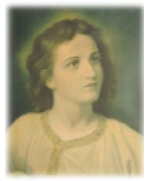
St. Frances of Rome
Friends in Christ, today is the feast of St. Frances of Rome. St. Frances was born in 1384. She was of nobility, married at the age of 12, and although her marriage had been arranged, it was a happy one, lasting for forty years. But there were sorrows. They lost two children to the plague.
.
In those days Rome was a horrid place, with violence, disease, and poverty; wolves were even known to roam the streets. All of this made Frances and her husband very sensitive, especially to the needs of the poor.
.
Marvelous things surrounded the life of Frances. Once when the army of Naples demanded their son as a hostage, Frances went to church and dedicated her son to the Blessed Virgin. When the troops arrived and put her son on a horse, the horse refused to move. The soldiers, seeing the hand of God in it, returned the boy to his mother.
.
But marvels through her life did not stop with external signs. Her prayers and her life became such an example to the wealthy ladies of Rome, that many in her social circles gave up their worldly lives to help the sick. These women eventually began the Benedictine Oblate Sisters, and after her husband’s death, Frances herself joined this order.
.
Having lived in this Benedictine Order, the Mother superior wrote this about Frances: With peace of soul Frances always accepted the will of God and gave him thanks for everything that happened. She endured the slander of those who reviled her, and did not show the least hint of aversion toward them. She habitually prayed to God for those against her.
.
The superior also said this: ‘God made Frances so lovable that anyone with whom she spoke was immediately captivated by love for her and ready to help in everything she wanted. Divine power was present and working in her words; in a few sentences she could bring consolation to those who were anxious, calm the restless, pacify the angry, and reconcile enemies. Frances seemed able to calm the passions of every type of person with a single word, and lead them to do whatever she asked. For this reason people flocked to her from all directions. Nevertheless, she openly rebuked them for their sins and fearlessly reproved what was evil.
.
St. Frances also had the special privilege of a visible presence of her guardian angel. She is the patron saint of automobile drivers, taxi drivers, the death of children, and widows.
Faith in Christ or the world?
3rd Sunday of Lent
‘Every kingdom divided against itself shall be brought to desolation, and house shall fall upon house. He that is not with Me, is against Me.’
.
Friends in the Lord, It is impossible to follow Jesus with a divided heart. If our house is the Catholic Faith given to us by Christ, then we cannot allow into the house of our heart, ideas or beliefs that contradict the Faith of Christ.
‘Every kingdom divided against itself will be brought to desolation, and house shall fall upon house.’
.
We all know people who wish to say they are Catholic, but while they keep one foot in the Church, the other is in the world. Today we speak not of human weakness – sins that occur because of temptation or passion – we speak of temptation against Faith; of knowingly going against Faith.
.
A young man recently told me – he didn’t ask – he told me – there is nothing wrong with gay marriage. This is a Catholic. He doesn’t seek truth from his religion, but from elsewhere. So yet again, I went through the explanations of the obvious, trying to appeal to his common sense, if not his religion.
– two boys can’t make a baby, I told him.
A man has half of a reproductive system, a woman has the other half; together, they form one reproductive system. Sexual love is ordered toward new life, it’s the purpose of marriage, family. This is not rocket science. Yes, sometimes the biology doesn’t work right, and a couple can’t have a child; but their gifts of sexuality are ORDERED toward children, this is their purpose. Our sexual faculties are meant for a purpose. If their use is not ordered toward new life, it is perversion. ‘There is no such thing as gay marriage,’ I told him.
.
A look of shock swept his face. ‘What about all those people getting married?’ I reiterated: ‘The State can issue its papers, it doesn’t matter; such marriages don’t exist.’
‘You can’t be serious,’ he said, ‘those aren’t marriages?’
‘Those marriages are imaginary, make-believe,’ I said.
.
Friends, I always leave such conversations sad; not because the world is crazy with crazy ideas, but because there is no Faith. The Church has always taught that Faith and Reason go together, they always match up. Yet today, the use of reason or logic seems to have no effect. I also read straight from the Holy Scriptures to this young man – no effect.
.
I later spoke about this incident with my nephew, who is a very intelligent young man. I said, ‘Peter, I try to explain what seems so obvious to people, but the latest ideas have complete control over them. And they won’t listen to the clear teachings of holy scripture either. Nothing.
.
He said to me, ‘Uncle, I’ve found the same thing in speaking with people, and I have concluded that the problem is, they need to decide if they are followers of Jesus Christ; in reality, most are not.
.
I’ve thought about what he said, and I think he is correct. Reasoning and explanations, the Scriptures, can help strengthen Faith, but if there is no Faith, all the explanations in the world are meaningless, because their Faith is in something else.
.
A strong Catholic for example, can listen to all kinds of explanations against the Faith, but he is completely unmoved by their arguments, why? Because he has Faith. Faith comes first. Faith is the ground for one’s world-view. If a person, deep-down, believes that the spirit of the world has it right, that the world knows the way of happiness – if the person, deep down thinks the Catholic Church needs to make changes to follow the REAL truth – the World – well then, that person has faith in the World, not in Christ. We can say that he has joined a new Denomination: the Church of the World. He has concluded that the Church of the World REALLY has the answers for happiness, and this faith underpins his whole view. That is the religion of the world, a different religion than Christianity, and they have joined it. Millions have joined it.
.
George Weigel[i] says, that many explanations have been given for the collapse of Catholicism in the west; but the primary reason, is that many people ceased to believe that the Gospel is true. There are some who chose to reject only one teaching of the Catholic Faith – but in doing so, they lost their Faith entirely. By picking and choosing in matters of Faith, one allows the Evil spirit in. As the Lord says: ‘that spirit then brings 7 other spirits more wicked than the first, and the last state of that man is worse than the first.’ St. Augustine says, ‘a person will possess the Holy Spirit in proportion to his reverence and adhesion to the Church of Christ.’
.
The core problem we have, is that many have switched their faith, and joined the Church of the World, and that faith is what informs their world-view. They really believe it.
.
Cardinal Ratzinger[ii] in his Introduction to Christianity says, Faith is that firm ground upon which we choose to stand. Faith is our response to the Divine Word that has come into the world. It is our response to Jesus. Faith means knowing that what cannot be seen, is more real and important than what can be seen.
.
The Church of the World teaches that what can be seen and experienced is all there is, and so the most important thing is that everyone should enjoy himself without restriction.
.
We must pray for an invincible and supernatural Faith which will rule our life; then we will say with St. John, ‘This is the victory which overcomes the world: our Faith.
.
‘What does it profit a man to gain the whole world but lose his soul?’ What does it profit a man to be accepted by his peers and praised, for conforming his opinions to the world, but to end in hell.
.
At death, the Church of the World sends no ministers to comfort the dying. There is no comfort to be had. There is no future for them.
.
But the dying Christian is blessed with Jesus and Mary there, who dwell with them and their Faith – their Faith in the world to come, which is waiting for them.
.
[Entrusted to the prayers of St. Mary Madelene]
.
[i] Evangelical Catholicism, p. 51.
[ii] Introduction to Catholicism, p. 43.
St. Perpetua and St. Felicity
Beloved in Christ,
In the first centuries of the Faith, Christians were often fed to the lions and other wild animals in the coliseum, to the cheers of bloodthirsty crowds. Two such great martyrs are Sts. Perpetua and Felicity, whom we remember today. They were beautiful girls, who were the best of friends; Perpetua was 22 years old, with long hair; Felicity was younger. Together they wanted to serve Christ, and be great Christian women.
Perpetua was her father’s favorite, and she also had a little baby; but her father, a pagan, often tried to get her to give up her Faith. Well one evening, while they were eating supper, there was a knock on the door. It was the imperial guards. The two girls were summoned to be interrogated.
News spread quickly, and a vast crowd gathered. The girls were seated on a platform before the judge. Perpetua wrote this in her diary: ‘They first questioned others about their Faith. When it was my turn, my father came to the front and held up my baby; he said, ‘Have pity on your child, and give up this religion.’ It hurt me to see this.
I was finally asked, ‘Are you a Christian.’ And I answered ‘Yes I am.’ ‘I was sad for my father, because he would have no joy when I became a martyr. Then the judge passed sentence on us, and condemned us to the wild beasts. That night in prison, I had a dream, and I saw that the next day, victory would be mine.’ In the morning, on the greatest day of their life, the girls woke up with excitement and marched to the Coliseum as if in a procession to heaven; they were singing.
Entering the arena, the roar of the crowd was deafening. The first attack came from a savage bull. Perpetua was tossed by the bull’s horns into the air, and thrown to the ground; there she was seen calmly pinning up her hair, in a state of happiness. When she was told of the attack, she could hardly believe it, until she saw the wounds on herself. She seemed to be in an ecstasy. With a smile she reassured the others saying, ‘Stand fast in the Faith.’
As she went to the aid of Felicity, who had also been tossed, the crowd began demanding their death; after giving each other the kiss of peace, they were killed by the gladiators. Perpetua was still alive after the first blow of the sword, and so she helped the nervous executioner, guide the sword to her own throat.
A witness to these things states: ‘That day a good many came to believe in Christ, for they had never seen so great a Christian woman, as Perpetua.’
No saints are more uniformly honored in the early calendars of the Church, than saints Perpetua and Felicity.
Fr. Luke Winkelmann
The death of sinners and saints
Friends in Christ, today our Lord explains the story of the poor man Lazarus, and the rich man. One goes to heaven, the other to hell. The rich man in hell, as we see, has many regrets.
.
It is true, that for the person who has neglected his salvation, at his death, he will feel many regrets of all the wasted time. (See Preparation for Death, St. Alphonsus, p. 84) Friends who visit him, who perhaps even sinned with him, will be reminders of the kind of life he led.
.
The dying man will think: ‘I could have led a life of happiness in the grace of God.’ And when will he think these things? When the lamp is going out, when the flame of life is nearly extinguished: What would he not give for even one more month, to prove his love for God.
.
But for the person who tried to love the Lord in this life – for this one, death is very sweet. The person with Faith in Jesus Christ – at his death, he will feel peace.
.
At her death, St. Teresa was so happy, that she rejoiced every time she heard the clock strike the hour, closer to death. In her moment of death, St. Catherine of Sienna was heard to say: ‘Rejoice with me, for I leave to go to the place of peace.’ St. Bruno says, the death of the just should not be called death, but life.
.
Those who live a bad life, nearly always will have a bad death. The man who loves sin in his life, will rarely ever repent at the end. St. Robert Bellarmine says that he once went to a dying man, and told him he had come to hear his Confession. But the man did not even know what Confession was. ‘Father, I do not understand what you are saying. St. Augustine says, the person who forgot God during life, will forget him in the end.
.
But the friends of God will welcome death. St. Charles Borromeo had a picture in the house he had moved into, a picture of the grim reaper with a sickle in his hand coming at death – seeing this, he sent for a painter and ordered him to erase the sickle, and to paint instead a golden key; a reminder that death is the key that opens Paradise.
.
We still have time. Lent is a time to turn from our sins, and walk again as children of the Light, and thereby not be afraid in the least of the day of our death.
An antidote to critical thoughts
Friends in Christ,
many people in their daily life find that they are plagued by critical thoughts. We of course notice the failings of others, we see irritating personalities, sinful lifestyles, corrupt politicians, and enemies of God. There are many things that, simply are wrong.
.
But this can lead us to fall into critical thoughts. Our Lord today refers really to this when he says, “Stop judging and you will not be judged. Stop condemning and you will not be condemned.’ So how are we to overcome critical thoughts?
.
When we see the faults of others, we cannot pretend that we did not see them. If a person is not teaching their kids the Faith, and we notice this, we cannot pretend that it is not happening. If we or a co-worker are being treated unjustly, we cannot pretend it is not happening. We are required to make judgments about what is going on. We need to be able to distinguish good from evil.
.
In the Gospel of St. Luke Chapter 13, Jesus says, ‘Why do you not JUDGE what is right?!’ So we must never approve of evil behavior. St. Paul says, ‘the spiritual man JUDGES all things.’ 1 Cor 2:15 So we HAVE to make judgments.
.
But when we see something wrong, there are two reactions we can have. The first is to say, ‘That person is a loser,’ or, we ‘write someone off’ as useless; in our mind we throw them on the trash heap. This is to condemn a person. Jesus says, ‘Do not condemn.’
.
The other reaction we could have, is to say, Lord, have mercy on us. ‘Help that person, and help me too.’ And we might have to address the wrong, if we can. We should also consider all of our own faults, and remind ourselves that we are all part of fallen humanity, we are all sinners in this together. As scripture says, ‘Lord, if you revealed all of my life’s sins, who could endure it?’
.
A person was recently feeling critical of a teenager’s behavior, but then he thought, ‘I guess I was kind of like that too.’ St. Francis de Sales says, we should try to always put the best spin on what we see in others. Lord, ‘He doesn’t know what he is doing.’ ‘Maybe that person had bad influences, or was taught wrong by his parents. ‘Look at how I’ve been blessed and so more is expected of me than this man.’
.
The point is, we can either play the role of Satan, which is to be the accuser, the condemner – or we can be another Christ, who intercedes for people, prays for sinners, and sometimes correct them. Yes, sometimes we should try to address the evil or wrong that we see, or speak to the person who is doing something bad; but with charity.
.
If we have condemning thoughts, we are really incapable of helping correct that person. You cannot correct someone that you do not love. But on the other hand, if our heart is merciful and understanding, we might very well be able to help them. Jesus sums up the attitude we should have: ‘Be merciful, just as your heavenly Father is merciful.’
Abraham, Isaac, and Christ
2nd Sunday of Lent
Beloved in Jesus Christ,
2000 years before the birth of Christ, Abraham obeyed a call by God to sacrifice his beloved Son, Isaac. No event of the Old Testament has been written about more by the ancient Jewish rabbis, than that one.[i] They knew that this mysterious event of Abraham offering his son, was somehow connected to the coming Messiah. But it has puzzled so-many people through history.
.
It is said that this was to test Abraham’s Faith. But why would God do this, ask a father to sacrifice his son? What does it mean? Well, the events of the Old Testament are recorded for the very purpose of pointing to the Savior to come, and the Sacrifice of Isaac is no exception.
.
Here are the facts: Abraham is asked to sacrifice his son. In those days, the sacrifice, usually an animal, was killed and then burned, as an offering to God. So, Abraham and Isaac go up the hill to sacrifice; Isaac carries the wood for it on his shoulders up the hill. On their way up, Isaac asks, ‘Father, where is the lamb for sacrifice?’ ‘God will provide the lamb,’ he replied.
.
When they reach the top of the hill, Isaac seems to realize that HE is to be the sacrifice, but he accepts it; he is bound with rope and as Abraham raises the knife to sacrifice his son, an angel from heaven says ‘Stop, do not harm the boy.’ Nevertheless, Abraham wanted to offer something to God; he saw a ram with its head, caught in a thorn bush, and so he offers the lamb in place of his son.
.
So what does this story mean? Well, Abraham is to offer his only beloved son, and this is an image of God the Father, who will offer his only Beloved Son, Jesus. As Isaac carried the wood for his own sacrifice up the hill, so did Jesus carry the wood of the cross up the hill of Calvary. Isaac is a symbol – a type of Jesus. Isaac is tied and bound with rope, and it is no coincidence, that the Gospel tells us that Jesus was also ‘bound,’ and led away to be crucified.
.
Now since this was a sign of the Messiah to come, the angel stops it and says, don’t continue. Isaac gets to live. But in place of Isaac, there is this ram that Abraham offers in his place, just as the true Lamb of God, Jesus, dies for us. That lamb had it’s head caught in a thorn bush, because as we know, Jesus had a crown of thorns pressed onto his head. The meaning of this event therefore, is that it is a sign of the coming Savior, who will die for our sins.
.
Now there is something more interesting here as well. It is often said that this was a test of Abraham’s Faith, But faith in what? What did Abraham believe in, that would make him do this? Well, many of the ancient rabbis actually believed that Isaac WAS sacrificed and immediately came back to life. Rabbi Eliezer was one of the greatest rabbis of the 1st century. He says: “When the knife touched Isaac, his soul departed, but when he heard the angel say ‘Stop,’ his soul returned, and Isaac arose. Isaac then believed that in the future the dead will rise.’
.
So did Abraham believe, that even if he killed his son, God would raise him up again, alive, to fulfill his promise?[ii] It seems so, because before he took Isaac up the hill, he told the people, ‘Wait here, and we will return.’ ‘We’ will return. How could they both return, if he would sacrifice him? Only if God returned Isaac to life.
.
St. Paul actually says the same thing in Hebrews. Heb 11:17 He says, ‘By faith Abraham reasoned that God had the power to raise up his son even from the dead, and so he received Isaac back as a sign of the resurrection to come.’
.
The entire Passion, Death, and Resurrection of Christ, was foretold in these remarkable events 4000 years ago. Abraham firmly believed that God could resurrect his son, this father, who brings his beloved son to die, this son, who carries the wood for his own death up the hill. The Lamb with head caught in the thorns; it was all a ‘dress-rehearsal’ for the events of our salvation.
.
And it is perhaps a stunning fact, that where it all happened, that place, was what would become the hill of Calvary.
.
Today, in the Transfiguration, Jesus, on another mountain, shows his disciples a glimpse of his glorious resurrection, and not only a glimpse of his own, but of our future as well. The faithful disciples of Christ will rise in glorified bodies; as Jesus said, ‘the just will shine like the sun, in the kingdom of their Father.’ This is our destiny, to be glorified like this in the world to come.
.
It was foretold by signs, in the Old Testament, it is demonstrated by Jesus in his Resurrection, and it is promised to us, if we remain faithful. St. Paul says, the Lord will transform our lowly bodies to be like his own, glorious body.
We say it every Sunday in the Creed: I believe in the resurrection of the Body, and the life of the world to come.
.
This 2nd Sunday of Lent, Mother Church has her children read this Gospel, about the Transfiguration, so that as we go through the sacrifices and challenge of Lent, we will keep our eyes fixed on the Easter joy ahead, on the glory of the life to come. If Lent is a symbol for the travails of this world, Easter is a sign of the joy of heaven.
.
This life isn’t easy, but as Scripture says: ‘The sufferings of this present time are nothing compared to the glory that will be revealed to us.
.
The Old Testament pointed to our destiny, in the Transfiguration Jesus reveals it to us, and as if to spur us on the more, Mary has already arrived there.
In the 12th chapter of the Book of Revelation, we see in heaven, ‘a Woman clothed with the sun.’ That’s Mary; she’s clothed with the sun, with God’s divinity, and she’s praying for us and waiting for us, until we get there too.
.
[Entrusted to the prayers of St. Anthony of Padua]
.
[i] The ancient manuscripts of the Talmud and Mishna call it, the ‘Binding of Isaac.’
[ii] God had promised Abraham years before, that all of his grandchildren and progeny would come through Isaac. How could this happen if he killed him? Only if he trusted that God would bring him back to life.